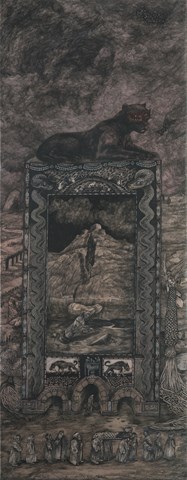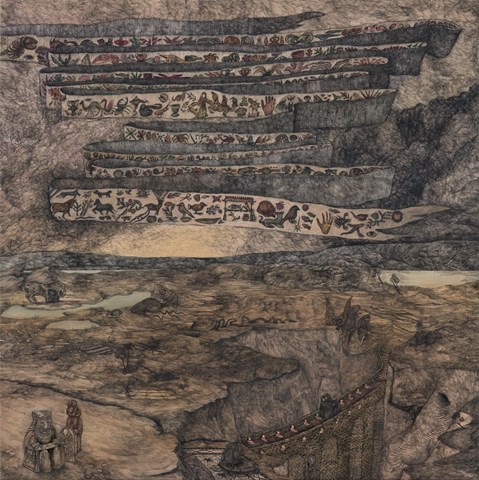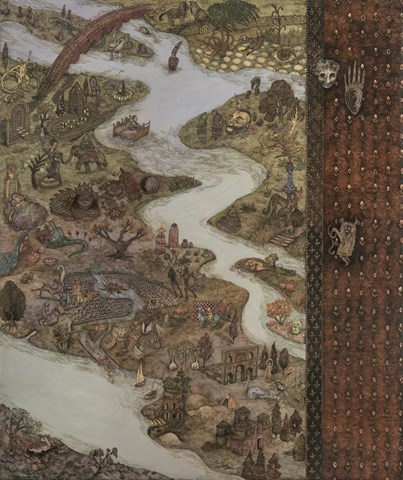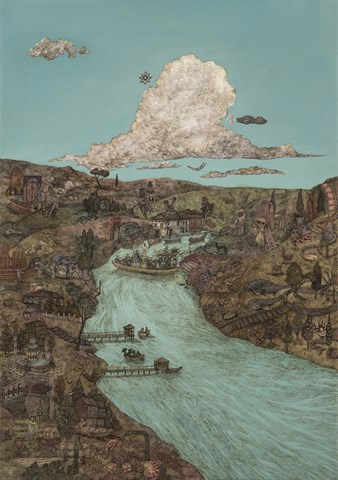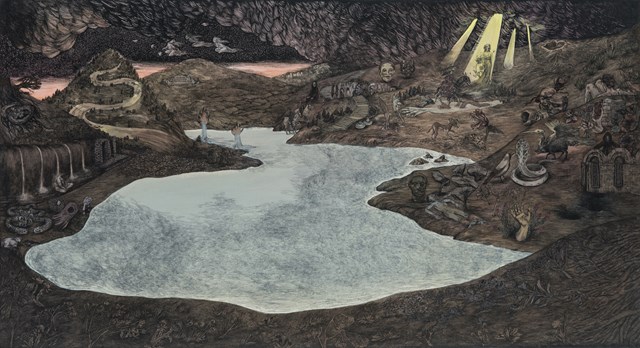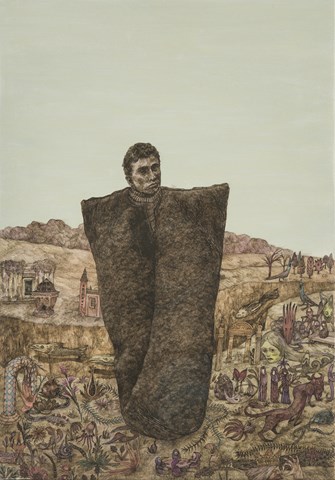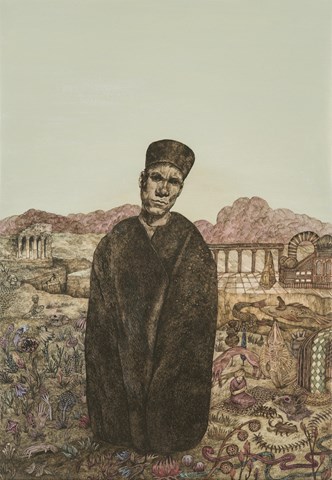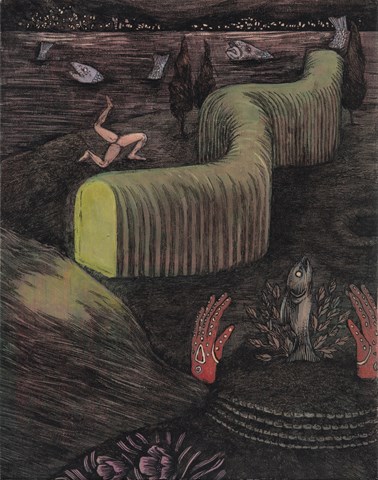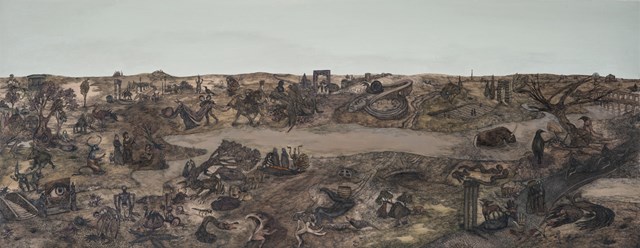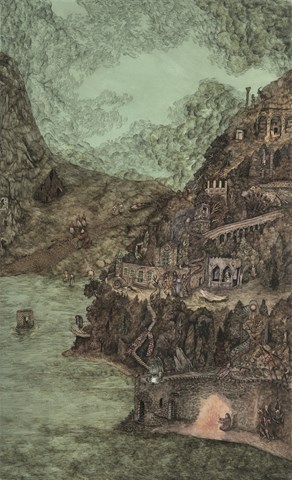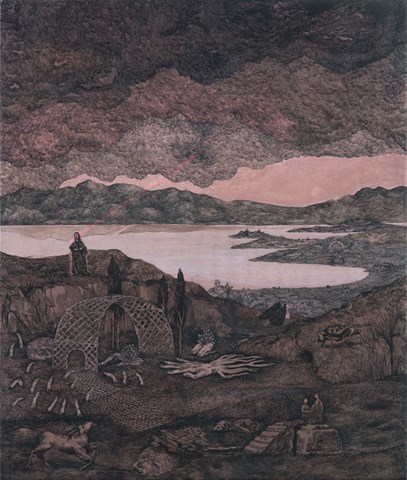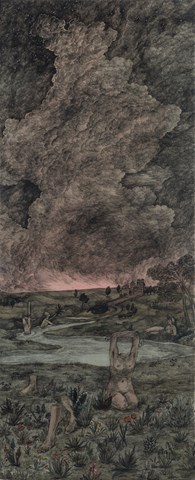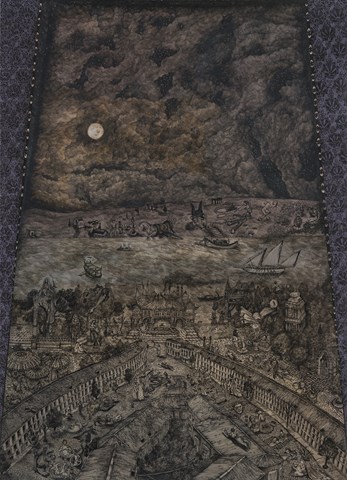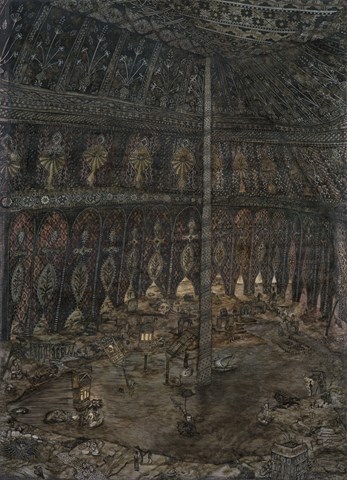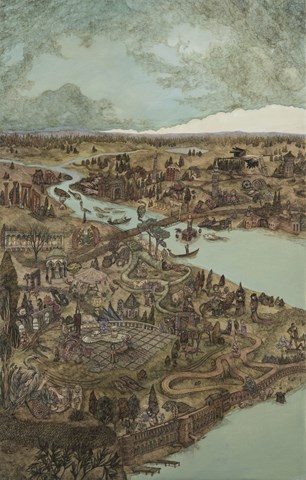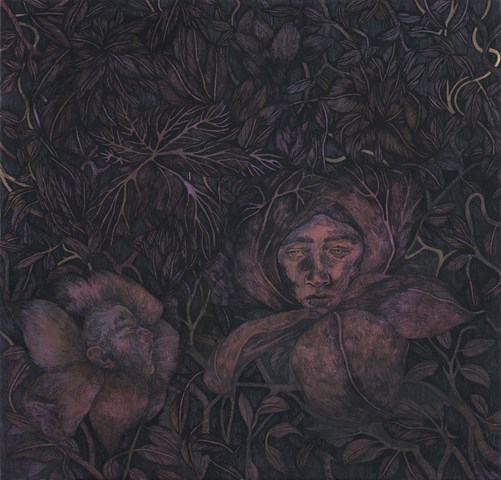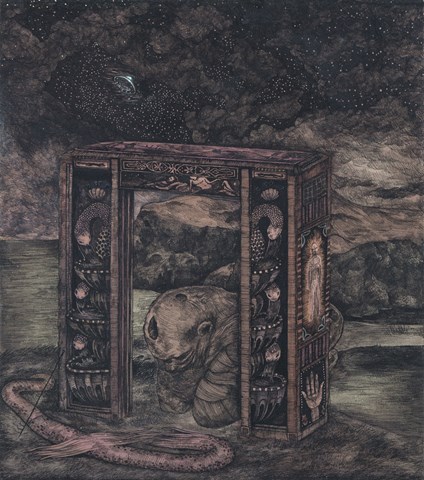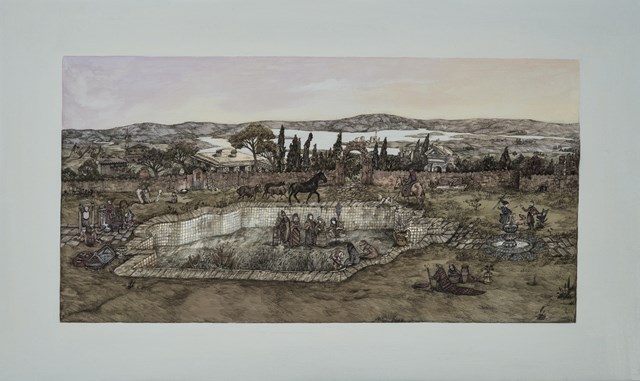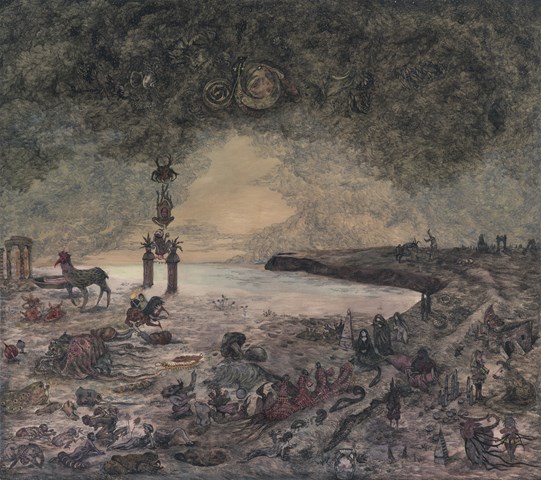

Khet emerges as a way of thinking about the form a pre-scriptural sound takes in the present. Uttered, it diminishes; once recorded, it leaves behind only its residue. In Burcu Urgut’s practice, this sound transforms not into an image but into a threshold. The artist constructs painting not as a represented scene, but as a surface of tension between presence and absence, movement and stillness, sound and trace.
Urgut’s production is grounded in a singular understanding of time shaped through the interplay of cinema, animation, and line. Within this body of work, no single narrative unfolds. Time is interrupted, layered, and segmented; distinct moments converge upon the same surface. The linear language that recalls nineteenth-century engravings is employed not to invoke the past, but to slow time down and suspend it. Images from different periods thus appear side by side, generating not a chronological order but an accumulated sense of memory.
The architectural elements, rituals, and scenes drawn from everyday life that appear in the works do not carry fixed meanings. Cultural traces extending from Anatolia to Mesopotamia, from the Levant to Egypt, meet not to construct a story but to converge upon a shared threshold. The word “Khet” likewise names this threshold; the meanings of cessation, interruption, and sealing embedded in the Turkish “ket” and the Semitic “khet” find a visual counterpart on the artist’s surface. These works are not progressing scenes but spaces that invite the viewer to slow down and pause.
Burcu Urgut’s works do not offer images to be glanced at and passed over; they propose surfaces that demand attentive looking and allow the layers of time to be felt. Khet stands at the center of the exhibition as a metaphor for the state of sound before it becomes image and for the trace it leaves in memory.
Acrylic and acrylic ink on canvas, 52 x 20.5 cm, 2025
Acrylic and acrylic ink on canvas, 45 x 45 cm, 2025
Acrylic and acrylic ink on canvas, 56 x 47 cm, 2026
Acrylic and acrylic ink on canvas, 51 x 35.5 cm, 2026
Acrylic and acrylic ink on canvas, 36 x 66 cm, 2025
Acrylic and acrylic ink on canvas, 40.5 x 28 cm, 2025
Acrylic and acrylic ink on canvas, 40.5 x 28 cm, 2025
Acrylic and acrylic ink on canvas, 19.5 x 15 cm, 2025
Acrylic and acrylic ink on canvas, 40 x 103 cm, 2025
Acrylic and acrylic ink on canvas, 51 x 31 cm, 2025
Acrylic and acrylic ink on canvas, 39 x 35.5 cm, 2025
Acrylic and acrylic ink on canvas, 50 x 20.5 cm, 2025
Acrylic and acrylic ink on canvas, 52 x 37.5 cm, 2025
Acrylic and acrylic ink on canvas, 61 x 44 cm, 2025
Acrylic and acrylic ink on canvas, 77 x 49 cm, 2025
Acrylic and acrylic ink on canvas, 22 x 22.5 cm, 2025
Acrylic and acrylic ink on canvas, 25.5 x 22 cm, 2025
Acrylic and acrylic ink on canvas, 30 x 50 cm, 2025
Acrylic and acrylic ink on canvas, 37 x 41 cm, 2025