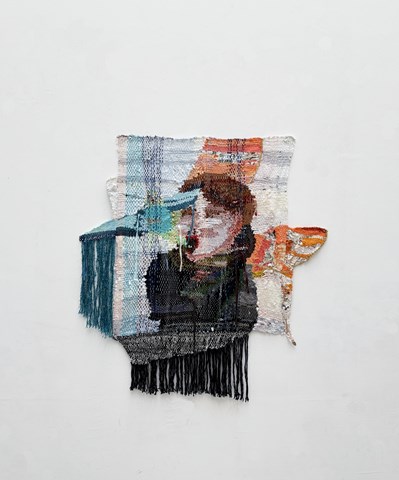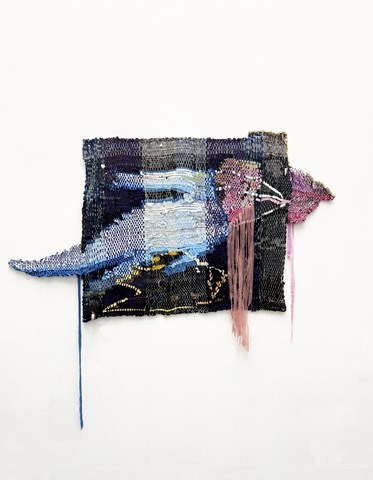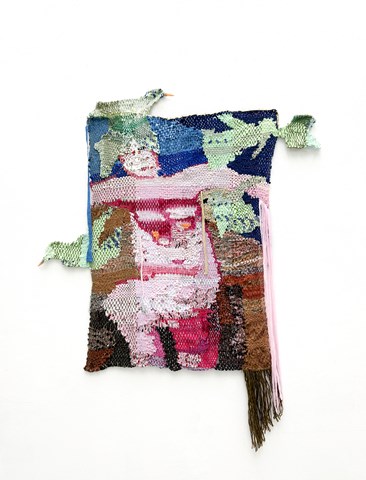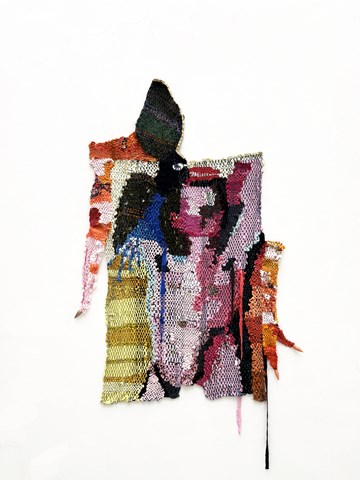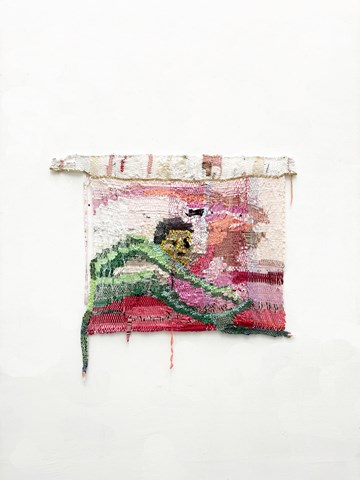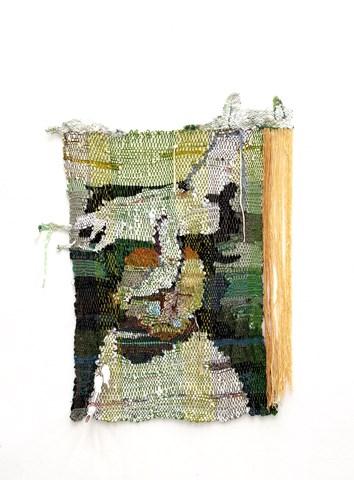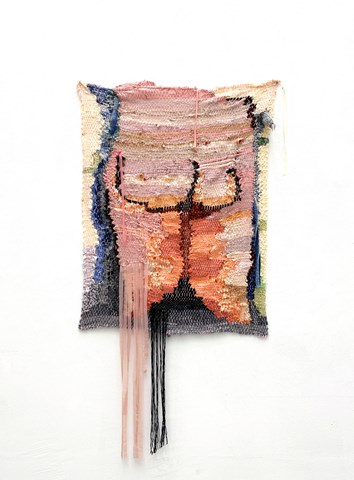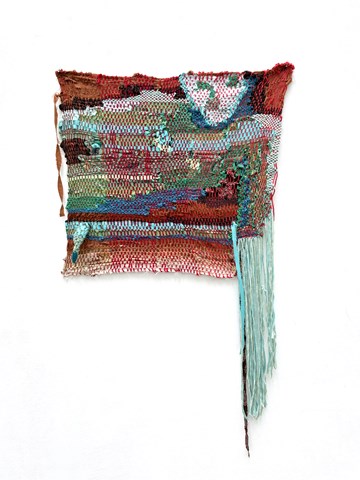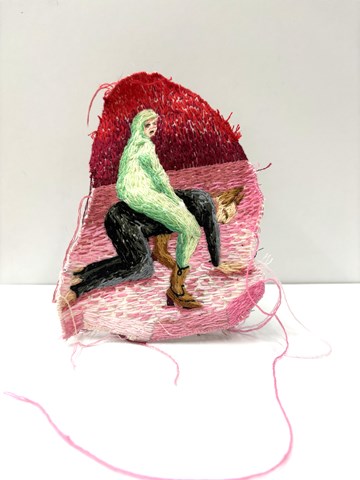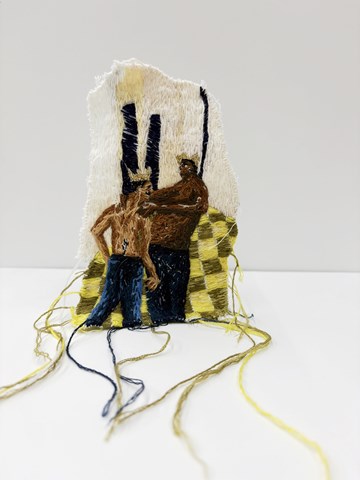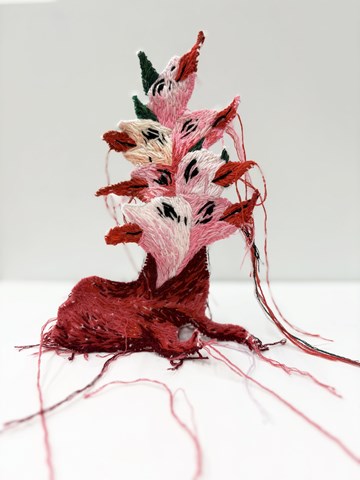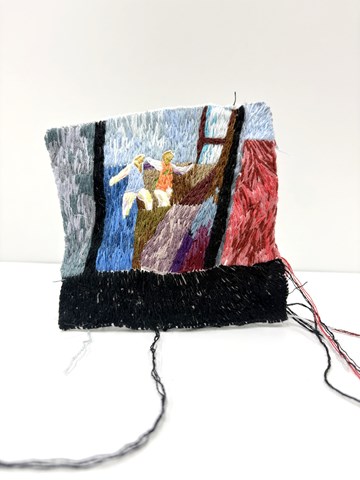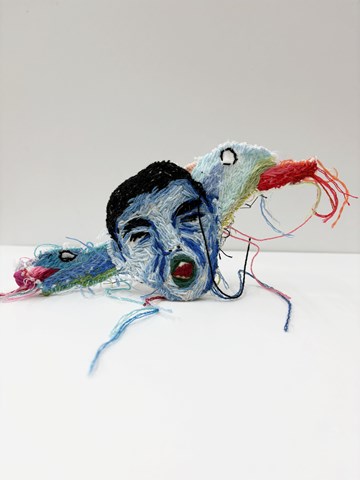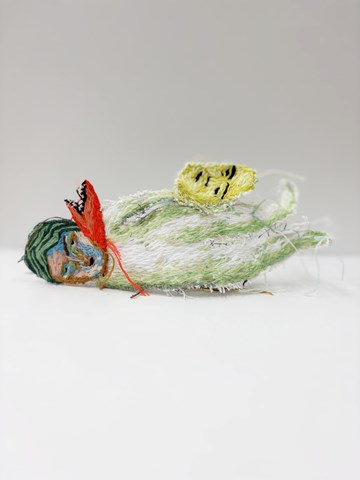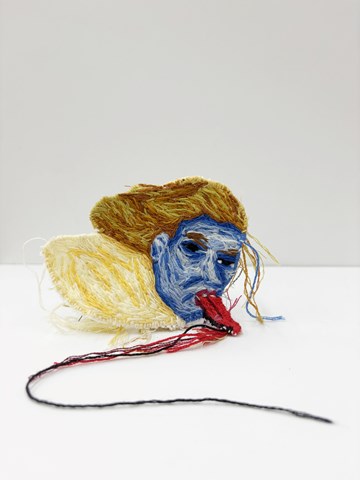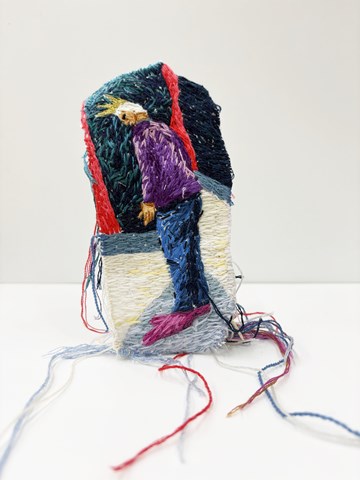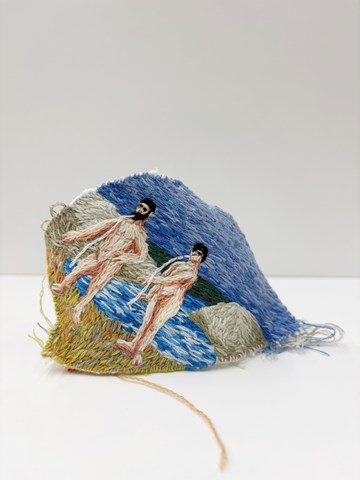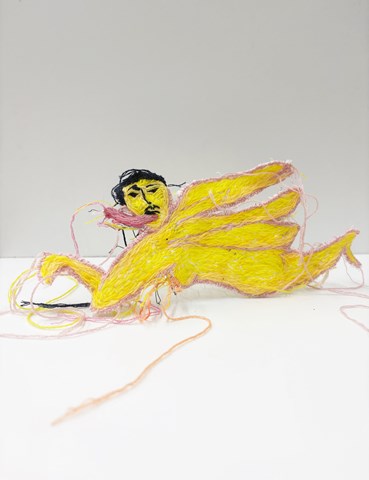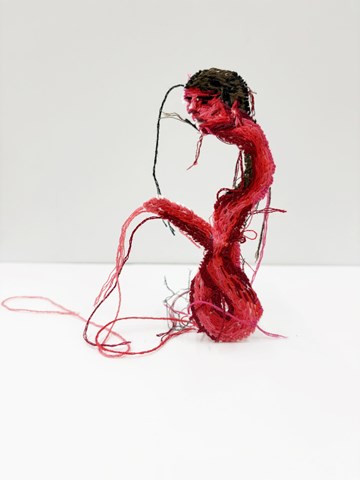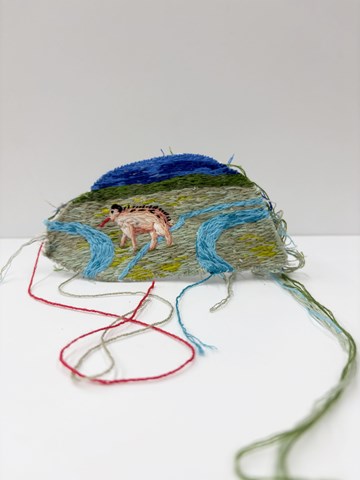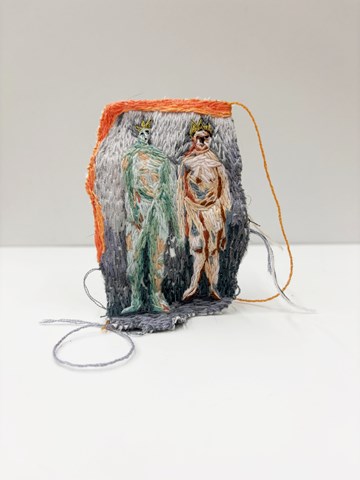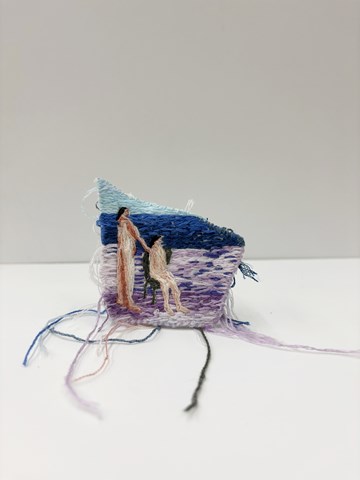

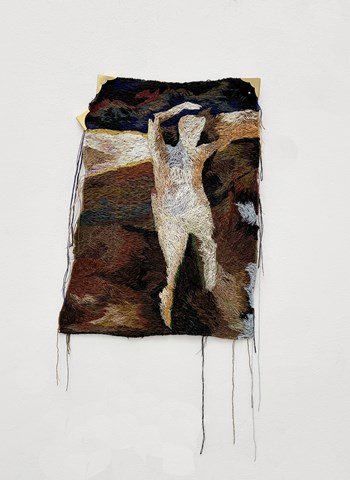
“Magical Escape” is a narrative motif in fairy tales and myths that describes a hero’s rescue from danger through a magical act of transformation. Rather than focusing on the dramatic moment of escape itself, this exhibition turns its attention to the uncertain and suspended threshold between one state and another where transformation takes place. In Seda Hepsev’s works, magic escape is approached not as a narrative of salvation but as a bodily, spatial and mental condition of transformation. This threshold is shaped less by the idea of an achieved destination than by notions of continuity, transience and movement.
The fabrics used in the production are largely obtained through donations or sourced from second-hand markets in Zurich. An anecdote from one of these markets constitutes a key conceptual point of departure for the exhibition: a winged figure drawn by a six- or seven-year-old girl is identified by the artist as a butterfly and by the child’s mother as a “fairy” while the child herself insists that she has drawn a fly. This moment gestures beyond the gendered clichés often projected onto winged figures and points instead to the presence of a creature like the fly—resilient and adaptable—in the imagination of a migrant child. Following this encounter, the artist begins to collect fabrics primarily from migrant communities, family members and her immediate social circle. The relationships formed and the stories shared throughout this process become an integral part of the production. The fabrics appear in the exhibition not merely as materials but as carriers of memory connected to the past, the body, the home and language. The reconfiguration of fabrics belonging to the past unfolds in parallel with a rethinking of the ways migration relates to space, the body and language.
The forms in the exhibition deliberately avoid fixity and certainty. Rather than settling into stable representations, they exist as fluid structures that evoke states of transformation and transition. The suspended presence of fabric within the exhibition space foregrounds continuity and movement over any sense of arrival or completion. Here, transformation is conceived not as an action that reaches an end point but as an ongoing and uninterrupted process. The conceptual axis of the exhibition takes shape within this perpetual state of becoming. In this sense, echoing Georges Didi-Huberman, memory is understood not only as something oriented toward the past but as a transformative force that opens toward the future and to new possibilities.
Hand-woven textile pieces, artificial nails, aluminum wire, 105 x 100 cm, 2025
Hand-woven textile pieces, artificial nails, aluminum wire, 100 x 120 cm, 2025
Hand-woven textile pieces, artificial nails, aluminum wire, 90 x 100 cm, 2025
Hand-woven textile pieces, artificial nails, aluminum wire, 105 x 90 cm, 2025
Hand-woven textile pieces, artificial nails, aluminum wire, 120 x 70 cm, 2025
Hand-woven textile pieces, artificial nails, aluminum wire, 78 x 85 cm, 2025
Hand-woven textile pieces, artificial nails, aluminum wire, 80 x 65 cm, 2025
Hand-woven textile pieces, artificial nails, aluminum wire, 100 x 50 cm, 2025
Hand-woven textile pieces, artificial nails, aluminum wire, 70 x 45 cm, 2025
Hand-woven textile pieces, artificial nails, aluminum wire, 45 x 75 cm, 2025
Hand-woven textile pieces, artificial nails, aluminum wire, 46 x 36 cm, 2025
Hand embroidery on fabric, aluminum wire, 18 x 14 cm, 2025
Hand embroidery on fabric, aluminum wire, 17 x 10 cm, 2025
Hand embroidery on fabric, aluminum wire, 22 x 14 cm, 2025
Hand embroidery on fabric, aluminum wire, 13 x 13 cm, 2025
Hand embroidery on fabric, aluminum wire, 20 x 9 cm, 2025
Hand embroidery on fabric, aluminum wire, 24 x 10 cm, 2025
Hand embroidery on fabric, aluminum wire, 9 x 10 cm, 2025
Hand embroidery on fabric, aluminum wire, 17 x 8 cm, 2025
Hand embroidery on fabric, aluminum wire, 3 x 8 cm, 2025
Hand embroidery on fabric, aluminum wire, 23 x 10 cm, 2025
Hand embroidery on fabric, aluminum wire, 15 x 6 cm, 2025
Hand embroidery on fabric, aluminum wire, 15 x 8 cm, 2025
Hand embroidery on fabric, aluminum wire, 12 x 8 cm, 2025
Hand embroidery on fabric, aluminum wire, 7 x 8 cm, 2025


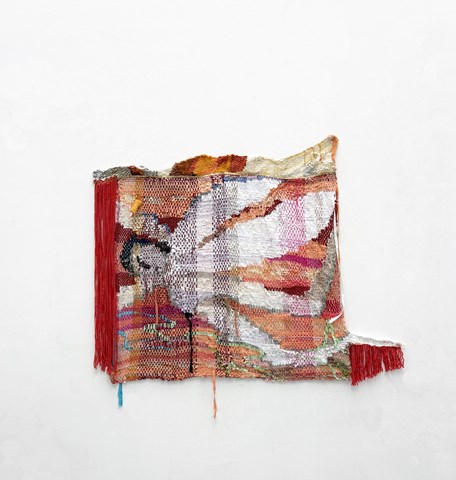
In Collection
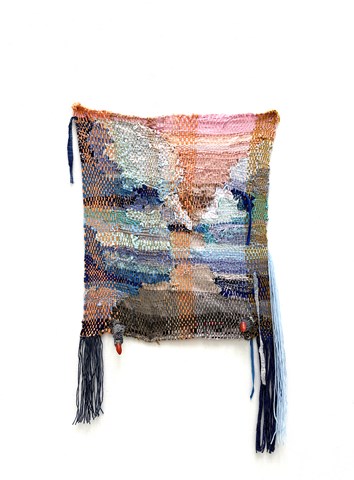
In Collection
In Collection